An Internet 100 times as fast: A new network design could boost capacity
June 28, 2010 by Larry Hardesty -->
In today’s Internet, data traveling through optical fibers as beams of light have to be converted to electrical signals for processing. By dispensing with that conversion, a new network design could increase Internet speeds 100-fold.
(PhysOrg.com) -- The heart of the Internet is a network of high-capacity optical fibers that spans continents. But while optical signals transmit information much more efficiently than electrical signals, they?re harder to control. The routers that direct traffic on the Internet typically convert optical signals to electrical ones for processing, then convert them back for transmission, a process that consumes time and energy.
Ethernet over SONET/SDH - Transition SONET/SDH networks to efficient carrier Ethernet [PDF] - www.ciena.com/Packet_Optical
In recent years, however, a group of MIT researchers led by Vincent Chan, the Joan and Irwin Jacobs Professor of Electrical Engineering and Computer Science, has demonstrated a new way of organizing optical networks that, in most cases, would eliminate this inefficient conversion process. As a result, it could make the Internet 100 or even 1,000 times faster while actually reducing the amount of energy it consumes.
One of the reasons that optical data transmission is so efficient is that different wavelengths of light loaded with different information can travel over the same fiber. But problems arise when optical signals coming from different directions reach a router at the same time. Converting them to electrical signals allows the router to store them in memory until it can get to them. The wait may be a matter of milliseconds, but there’s no cost-effective way to hold an optical signal still for even that short a time.
Chan’s approach, called “flow switching,” solves this problem in a different way. Between locations that exchange large volumes of data — say, Los Angeles and New York City — flow switching would establish a dedicated path across the network. For certain wavelengths of light, routers along that path would accept signals coming in from only one direction and send them off in only one direction. Since there’s no possibility of signals arriving from multiple directions, there’s never a need to store them in memory.
Reaction time
To some extent, something like this already happens in today’s Internet. A large Web company like Facebook or Google, for instance, might maintain huge banks of Web servers at a few different locations in the United States. The servers might exchange so much data that the company will simply lease a particular wavelength of light from one of the telecommunications companies that maintains the country’s fiber-optic networks. Across a designated pathway, no other Internet traffic can use that wavelength.
1GB - 10GB Transceivers - Cisco 3com Dlink Extreme Foundry HP Factory New, In Stock, Great Price - www.advantageoptics.com
In this case, however, the allotment of bandwidth between the two endpoints is fixed. If for some reason the company’s servers aren’t exchanging much data, the bandwidth of the dedicated wavelength is being wasted. If the servers are exchanging a lot of data, they might exceed the capacity of the link.
In a flow-switching network, the allotment of bandwidth would change constantly. As traffic between New York and Los Angeles increased, new, dedicated wavelengths would be recruited to handle it; as the traffic tailed off, the wavelengths would be relinquished. Chan and his colleagues have developed network management protocols that can perform these reallocations in a matter of seconds.
In a series of papers published over a span of 20 years — the latest of which will be presented at the OptoElectronics and Communications Conference in Japan next month — they’ve also performed mathematical analyses of flow-switched networks’ capacity and reported the results of extensive computer simulations. They’ve even tried out their ideas on a small experimental optical network that runs along the Eastern Seaboard.
Their conclusion is that flow switching can easily increase the data rates of optical networks 100-fold and possibly 1,000-fold, with further improvements of the network management scheme. Their recent work has focused on the power savings that flow switching offers: In most applications of information technology, power can be traded for speed and vice versa, but the researchers are trying to quantify that relationship. Among other things, they’ve shown that even with a 100-fold increase in data rates, flow switching could still reduce the Internet’s power consumption.
Growing appetite
Ori Gerstel, a principal engineer at Cisco Systems, the largest manufacturer of network routing equipment, says that several other techniques for increasing the data rate of optical networks, with names like burst switching and optical packet switching, have been proposed, but that flow switching is “much more practical.” The chief obstacle to its adoption, he says, isn’t technical but economic. Implementing Chan’s scheme would mean replacing existing Internet routers with new ones that don’t have to convert optical signals to electrical signals. But, Gerstel says, it’s not clear that there’s currently enough demand for a faster Internet to warrant that expense. “Flow switching works fairly well for fairly large demand — if you have users who need a lot of bandwidth and want low delay through the network,” Gerstel says. “But most customers are not in that niche today.”
But Chan points to the explosion of the popularity of both Internet video and high-definition television in recent years. If those two trends converge — if people begin hungering for high-definition video feeds directly to their computers — flow switching may make financial sense. Chan points at the 30-inch computer monitor atop his desk in MIT’s Research Lab of Electronics. “High resolution at 120 frames per second,” he says: “That’s a lot of data.”
Provided by Massachusetts Institute of Technology (news : web)
www.snorgtees.com" target="_top" />
Move the slider to adjust rank threshold, so that you can hide some of the comments.
Wednesday, June 30, 2010
An Internet 100 times as fast: A new network design could boost capacity


Tuesday, June 29, 2010
21 Things You Should Never Buy New - Yahoo! Finance
Wise Bread, On Monday June 28, 2010, 10:24 am EDTIf you're looking to get the most value for your dollar, it would do your wallet good to check out secondhand options. Many used goods still have plenty of life left in them even years after the original purchase, and they're usually resold at a fraction of the retail price, to boot. Here's a list of 21 things that make for a better deal when you buy them used.
[Slideshow: 10 Things to Splurge on This Summer.]
1. DVDs and CDs: Used DVDs and CDs will play like new if they were well taken care of. Even if you wind up with a scratched disc and you don't want to bother with a return, there are ways to remove the scratches and make the DVD or CD playable again.
2. Books: You can buy used books at significant discounts from online sellers and brick-and-mortar used book stores. The condition of the books may vary, but they usually range from good to like-new. And of course, check out your local library for free reading material.
3. Video Games: Kids get tired of video games rather quickly. You can easily find used video games from online sellers at sites like Amazon and eBay a few months after the release date. Most video game store outlets will feature a used game shelf, as well. And if you're not the patient type, you can rent or borrow from a friend first to see if it's worth the purchase.
4. Special Occasion and Holiday Clothing: Sometimes you'll need to buy formal clothing for special occasions, such as weddings or prom. Most people will take good care of formal clothing but will only wear it once or twice. Their closet castouts are your savings: Thrift stores, yard sales, online sellers and even some dress shops offer fantastic buys on used formalwear.
5. Jewelry: Depreciation hits hard when you try to sell used jewelry, but as a buyer you can take advantage of the markdown to save a bundle. This is especially true for diamonds, which has ridiculously low resale value. Check out estate sales and reputable pawn shops to find great deals on unique pieces. Even if you decide to resell the jewelry later, the depreciation won't hurt as much.
6. Ikea Furniture: Why bother assembling your own when you can pick it up for free (or nearly free) on Craigslist and Freecycle? Summer is the best time to hunt for Ikea furniture--that's when college students are changing apartments and tossing out their goodies.
7. Games and Toys: How long do games and toys remain your child's favorite before they're left forgotten under the bed or in the closet? You can find used children's toys in great condition at moving sales or on Craigslist, or you can ask your neighbors, friends, and family to trade used toys. Just make sure to give them a good wash before letting junior play.
8. Maternity and Baby Clothes: Compared to everyday outfits that you can wear any time, maternity clothes don't get much wear outside the few months of pregnancy when they fit. The same goes for baby clothes that are quickly outgrown. You'll save a small fortune by purchasing gently used maternity clothes and baby clothes at yard sales and thrift stores. Like children's games and toys, friends and family may have baby or maternity clothing that they'll be happy to let you take off their hands.
[See 20 Things You Should Never Buy Used.]
9. Musical Instruments: Purchasing new musical instruments for a beginner musician is rarely a good idea. (Are you ready to pay $60 an hour for piano lessons?) For your little dear who wants to learn to play an instrument, you should see how long his or her interest lasts by acquiring a rented or used instrument to practice with first. Unless you're a professional musician or your junior prodigy is seriously committed to music, a brand new instrument may not be the best investment.
10. Pets: If you buy a puppy (or kitty) from a professional breeder or a pet store outlet, it can set you back anywhere from a few hundred dollars to several thousand dollars. On top of this, you'll need to anticipate additional fees and vet bills, too. Instead, adopt a pre-owned pet from your local animal shelter and get a new family member, fees, and vaccines at a substantially lower cost.
11. Home Accent: Pieces Home decorating pieces and artwork are rarely handled on a day-to-day basis, so they're generally still in good condition even after being resold multiple times. If you like the worn-out look of some decor pieces, you can be sure you didn't pay extra for something that comes naturally with time. And don't forget, for most of us, discovering a true gem at a garage sale is 90% of the fun!
12. Craft Supplies: If you're into crafting, you probably have a variety of different supplies left over from prior projects. If you require some additional supplies for your upcoming project, then you can join a craft swap where you'll find other crafty people to trade supplies with. If you have leftovers, be sure to donate them to your local schools.
13. Houses: You're typically able to get better and more features for your dollar when you purchase an older home rather than building new. Older houses were often constructed on bigger corner lots, and you also get architectural variety in your neighborhood if the houses were built or remodeled in different eras.
14. Office Furniture: Good office furniture is built to withstand heavy use and handling. Really solid pieces will last a lifetime, long after they're resold the first or second time. A great used desk or file cabinet will work as well as (or better than) a new one, but for a fraction of the cost. With the recession shutting down so many businesses, you can easily find lots of great office furniture deals.
15. Cars: You've probably heard this before: Cars depreciate the second you drive them off of the dealership's lot. In buying a used car, you save money on both the initial cost and the insurance. It also helps to know a trusty mechanic who can check it over first. This way, you'll be aware of any potential problems before you make the purchase.
[See 20 Tips for Cleaning on the Cheap.]
16. Hand Tools: Simple tools with few moving parts, like hammers, hoes and wrenches, will keep for decades so long as they are well-made to begin with and are well-maintained. These are fairly easy to find at neighborhood yard or garage sales. If you don't need to use hand tools very often, an even better deal is to rent a set of tools or borrow them from a friend.
17. Sports Equipment: Most people buy sports equipment planning to use it until it drops, but this rarely happens. So when sports equipment ends up on the resale market, they tend to still be in excellent condition. Look into buying used sporting gear through Craigslist and at yard sales or sports equipment stores.
18. Consumer Electronics: I know most folks like shiny new toys, but refurbished electronic goods are a much sweeter deal. Consumer electronics are returned to the manufacturer for different reasons, but generally, they'll be inspected for damaged parts, fixed, tested, then resold at a lower price. Just make sure you get a good warranty along with your purchase.
19. Gardening Supplies: This is an easy way for you to save money, and all you need to do is be observant. Take a look outdoors and you'll likely find such gardening supplies as mulch, wood, and even stones for free or vastly reduced prices. Used garden equipment and tools are also common goods at yard sales.
20. Timeshares: Buying timeshares isn't for everyone, but if you decide that it suits your lifestyle, purchasing the property as a resale would be a better deal than buying it brand new: on average, you'll save 67 percent on the price for a comparable new timeshare. If you're new to timeshare ownership, give it a test run first by renting short term.
21. Recreational Items: It's fairly easy to find high ticket recreational items like campers, boats, and jet skis being resold. Oftentimes, they're barely used at all. As long as they're in safe, working condition, they'll make for a better value when purchased used than new.
Lynn Truong is the co-founder and Deals Editor of Wise Bread, a blog dedicated to helping readers live large on a small budget. Wise Bread's book, 10,001 Ways to Live Large on a Small Budget, debuted as the #1 Money Management book on Amazon.com.
Thursday, June 24, 2010
Success in Selling … for Introverts Like Me | The Total Package
Five key principles for using your individuality in your marketing that will transform your sales and easily attract the right kind of buyers into your business.
I don’t have nearly the experience, breadth or track record Drayton does, but I would like to add my two cents worth on this as well.
- Be your best, most authentic self in your marketing
- Talk with your clients and prospects – not at them
- Keep it short and punchy, while still getting your main points across (to introverts like me, nothing drives me more crazy than someone, especially sales people, who drone on and on about nothing!)
- Find unique ways to inject humbleness and humor in your marketing
- Talk about things highly personal to you: your children, your pets, your spouse, your passions or hobbies. Talking about those things easy draws out the passion in your writing. Make sure you adhere to point #3 above though while doing this!
- Actually spend some time getting to know who you are talking to. Unlike the aggressive sales person example: they don’t care who you are – only that you have a credit card in hand (think much of the nonsense going on in the ‘guru’ space these days. Gotta credit card? Good – you are my ideal client!).
- Find a good story in everything. Again, introverts aren’t typical story tellers – but they can learn to be. Dale Carnegie Training (the Human Relations course) is excellent for this. As is the book The Artists Way.
- Have a toolkit with three or five core stories you can tell. Bring them out when the person and situation is appropriate. Just because you have told the story 50 times, doesn’t mean they have heard it before.
- Be real, and follow your intuition when dealing with people. Canned approaches shine through – but genuine personality glows MUCH brighter.
Wednesday, June 16, 2010
Top 50 Ruby on Rails Websites

I find it ironic how Twitter and Linkedin tend go down often. Hmmmm...could it be a RoR problem?
Tuesday, June 15, 2010
The purpose of Water Towers
From Wikipedia, the free encyclopedia
Jump to: navigation, searchFor the water tower in Chicago, see Chicago Water Tower. For the skyscraper in Chicago, see Water Tower Place.For other uses, see Water Tower (disambiguation).
This article needs additional citations for verification.
Please help improve this article by adding reliable references. Unsourced material may be challenged and removed. (April 2008)
Completed in 1860.A water tower or elevated water tower is a large elevated water storage container constructed to hold a water supply at a height sufficient to pressurize a water distribution system. Pressurization occurs through the elevation of water; for every 10.20 centimetres (4.016 in) of elevation, it produces 1 kilopascal (0.145 psi) of pressure. 30 m (98.43 ft) of elevation produces roughly 300 kPa (43.511 psi), which is enough pressure to operate and provide for most domestic water pressure and distribution system requirements.
Many water towers were constructed during the Industrial Revolution; some are now considered architectural landmarks and monuments, and may not be demolished. Some are converted to apartments or exclusive penthouses.
In certain areas, such as New York City in the United States, smaller water towers are constructed for individual buildings.
Contents
[hide][edit] Construction
A variety of materials can be used to construct a typical water tower; steel and reinforced or prestressed concrete are most often utilized (with wood, fiberglass, or brick also in use), incorporating an interior coating to protect the water from any effects from the lining material. The tower is usually spherical, cylindrical, or an ellipsoid, with a minimum height of approximately 6 metres (20 ft) and a minimum of 4 m (13 ft) in diameter. A standard water tower typically has a height of approximately 40 m (130 ft).
[edit] Purpose
Shooter's Hill water tower is a local landmark in London, United Kingdom. Water towers are very common around London suburbs.The users of the water supply (a town, factory, or just a building) need to have water pressure to maintain the safety of the water supply. If a water supply is not pressurized sufficiently, several things can happen:
- Water may not reach the upper floors of a building;
- Water may not spray from a tap with sufficient flow
- Without a water tower, parts of gravity flow water supply systems in hilly areas may be subject to negative pressures (see siphon). Negative pressure in the system may cause shallow groundwater to be pulled into a leaky water supply system, polluting it with microorganisms, dirt, sand, fertilizers, and any other toxic contaminants that may be in the groundwater;
Water towers are able to supply water even during power outages, because they rely on pressure produced by elevation of water (due to gravity) to push the water into domestic and industrial water distribution systems; however, they cannot supply the water for a long time without electricity, because a pump is required to refill the tower. A water tower also serves as a reservoir to help with water needs during peak usage times. The water level in the tower typically falls during the peak usage hours of the day, and then a pump fills it back up during the night. This process also keeps the water from freezing in cold weather, since the tower is constantly being drained and refilled.
[edit] Operation
How a water tower works:
1. Pump station
2. Reservoir
3. Water userThe height of the tower provides the hydrostatic pressure for the water supply system, and it may be supplemented with a pump. The volume of the reservoir and diameter of the piping provide and sustain flow rate. However, relying on a pump to provide pressure is expensive; to keep up with varying demand, the pump would have to be sized to meet peak demands. During periods of low demand, jockey pumps are used to meet these lower water flow requirements. The water tower reduces the need for electrical consumption of cycling pumps and thus the need for an expensive pump control system, as this system would have to be sized sufficiently to give the same pressure at high flow rates.
Very high volumes and flow rates are needed when fighting fires. With a water tower present, pumps can be sized for average demand, not peak demand; the water tower can provide water pressure during the day and pumps will refill the water tower when demands are lower.
Using wireless sensor networks to monitor water levels inside the tower allows municipalities to automatically monitor and control pumps without installing, and maintaining, expensive data cables.[1]
[edit] Decoration
Water towers can be surrounded by ornate coverings including fancy brickwork, a large ivy-covered trellis or they can be simply painted. Some city water towers have the name of the city painted in large letters on the roof, as a navigational aid to aviators. Sometimes the decoration can be humorous, as Granger, Iowa has two water towers, labeled HOT and COLD. The House in the Clouds in Thorpeness, located in the English county of Suffolk, was built to resemble a house in order to disguise the eyesore, whilst the lower floors were used for accommodation. When the town was connected to the mains water supply, the water tower was dismantled and converted to additional living space.
Sapp Bros. truck stops use a water tower with a handle and spout – looking like a coffee pot – as the company logo. Many of their facilities have decorated actual water towers (presumably non-functional) on-site.
The first and original "Mushroom" – Svampen in Swedish – was built in Örebro in Sweden in the early 1950s and later copies were built around the world including Saudi-Arabia and Kuwait.[citation needed]
Many small towns in the United States use their water towers to advertise local tourism, their local high school sports teams, or other locally notable factoids. Since the water tower is sometimes the highest point in the town, antennae, public address systems, cameras and tornado warning sirens are sometimes placed on them as well.
[edit] Water Towers around the World
This section requires expansion. See also: Architecture in New York City
In the 1800s, New York City required that all buildings higher than six stories be equipped with a rooftop water tower. This was necessary to prevent the need for excessively high pressures at lower elevations, which could burst pipes.[citation needed] In modern times, the towers have become fashionable in some circles. As of 2006[update], the neighborhood of Tribeca requires water towers on all buildings, whether or not they are being used. Two companies in New York build water towers, both of which are family businesses in operation since the 1800s.[2]
The original water tower builders were barrel makers who expanded their craft to meet a modern need as buildings in the city grew taller in height. Even today, no sealant is used to hold the water in. The wooden walls of the Water Tower are held together with cables but leak through the gaps when first filled. As the water saturates the wood it swells, the gaps close and become impermeable.[3]
The rooftop water towers store 25,000 litres (5,500 imp gal) to 50,000 litres (11,000 imp gal) of water until it is needed in the building below. The upper portion of water is skimmed off the top for everyday use while the water in the bottom of the tower is held in reserve to fight fire. When the water drops below a certain level, a pressure switch, level switch or float valve will activate a pump or open a public water line to refill the water tower.[3]
Architects and builders have taken varied approaches to incorporating water towers into the design of their buildings. On many large commercial buildings, water towers are completely hidden behind an extension of the facade of the building. For cosmetic reasons, apartment buildings often enclose their tanks in rooftop structures, either simple unadorned rooftop boxes, or ornately decorated structures intended to enhance the visual appeal of the building. Many buildings, however, leave their water towers in plain view atop utilitarian framework structures.
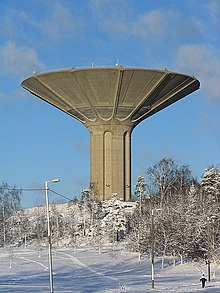
The mushroom-shaped concrete water tower of Roihuvuori in Helsinki, Finland was built in the 1970s. It is 52 metres high and can hold around 12,000 m³ of water.Water towers are very common in India, where the electricity supply is erratic in most places.
In many countries, water towers have been taken out of the water supply system and replaced by pumps alone. However, this approach is dependent on continuous pumping; if the pumps fail (such as during a power outage), then water pressure will be lost, causing potential public health concerns. Many states require a "boil water" notice to be issued if water pressure drops below 20 psi.
Water towers are often regarded as monuments of civil engineering.[citation needed] Some are converted to serve modern purposes, as for example, the Wieża Ciśnień in Wroclaw, Poland which is today a restaurant complex.
Historically, railroads that used steam locomotives required a means of replenishing the locomotive's tenders. Water towers were common along the railroad. The tenders were usually replenished by water cranes, which were fed by a water tower.
Some water towers are also used as observation towers, and some restaurants, such as the Goldbergturm in Sindelfingen, Germany, or the second of the three Kuwait Towers, in the City-State of Kuwait. It is also common to use water towers as the location of transmission mechanisms in the UHF range with small power, for instance for closed rural broadcasting service, portable radio, or cellular telephone service.
Unused water towers can be employed for their energy storing capacity to generate electricity from renewable energy sources. For example, if a tower is coupled with a wind turbine, the storing capacity of the water tower can be used to store erratic wind energy, and to create a steady power source.[citation needed]
In hilly regions, local topography can be substituted for structures to elevate the tanks. These tanks are often nothing more than concrete cisterns terraced into the sides of local hills or mountains, but function identically to the traditional water tower. The tops of these tanks can be landscaped or used as park space, if desired.
[edit] Alternatives
Alternatives to water towers are simple pumps mounted on top of the water pipes to increase the water pressure.[4]. This new approach is more straightforward, but also more subject to potential public health risks; if the pumps fail, then loss of water pressure will result in potential public health impacts, typically associated with entry of contaminants into the water system. Most large water utilities do not use this approach, given the potential risks. [citation needed]
[edit] Famous Towers
Twin water towers in Goole, East Riding of Yorkshire, dubbed the "salt and pepper pots". Note the two distinct ages and architectual types[edit] Canada
[edit] Slovenia
[edit] United Kingdom
[edit] United States
- Chicago Water Tower in Chicago, Illinois
- Volunteer Park Water Tower in Capitol Hill, Seattle, Washington
- Warner Bros. Studios Water Tower in Burbank, California (In the animated TV series Animaniacs, it was used to incarcerate the characters Yakko, Wakko, and Dot, as well as their home.)
- Peachoid next to I-85 on the edge of Gaffney, South Carolina
- Earful Tower at Disney's Hollywood Studios
- Florence Y'all Water Tower in Florence, Kentucky
- Union Water Sphere in Union Township, New Jersey
- Ypsilanti Water Tower (Winner of the Most Phallic Building contest)
- Corn Cob Water Tower in Rochester, Minnesota
- Leaning Water Tower in Groom, Texas
- Old Rustic, Warner Brother's style Water Towers (possibly from the 1920s) around peanut plants and more in Ozark, AL
[edit] Gallery
Painted watertower overlooking the Show Place Arena in Prince George's County, Maryland, United States.
Water tower by V.Shukhov - the world's first hyperboloid structure, Russia, 1896.
The local water tower at Grandview in Hampton, Virginia, United States.
Brick-built water tower in Kimberley, Nottinghamshire, United Kingdom.
Everton Water Tower in Liverpool, United Kingdom.
Water tower at Saint-Parize-Le-Chatel, France.
Unique water tower in the shape of a ketchup bottle, Collinsville, Illinois, United States. This is also the world's largest ketchup bottle.
Leaning water tower, found east of Groom, Texas along I-40 (old U.S. Route 66). A common landmark in old Route 66 photography.
1960s water tower shaped like a cone, Tonwell, Hertfordshire, United Kingdom.
The Peachoid water tower in Gaffney, South Carolina, United States, built in 1981.
The old and new water towers in Nicollet, Minnesota, United States.
Water tower in Melbourne, Florida, United States.
Water tower in Claxton, Georgia, United States.
Water tower in Blaine, Minnesota, United States.
A typical Midwestern water tower in Salina, Kansas, United States.
Auburn Tigers-themed tower in Auburn, Alabama, United States.
Former Darwin RAAF control and water tower.
Typical water tower in Russian countryside.
Water tower in Beaver, Ohio, United States. This is the tallest structure in the rural village.
Water tower in the hamlet of Olcott Beach, part of Newfane, New York, United States.
Jumbo, a water tower in Colchester, Essex, United Kingdom.
Disused water tower in Banks, Lancashire, United Kingdom.
Former water tower in Oberkrämer-Schwante.
[edit] See also
- American Water Landmark
- Gas holder, a similar utility storage structure
- Hyperboloid structure
[edit] References
- ^ Banner Engineering (November 2009), Application Notes, http://www.bannerengineering.com/en-US/wireless/surecross_web_appnotes
- ^ "Wondering About Water Towers" by Debbie Elliott. All Things Considered, 2 December 2006. National Public Radio. http://www.npr.org/templates/story/story.php?storyId=6567297 (includes pictures)
- ^ a b Charles, Jacoba (2007-06-03). "Longtime Emblems of City Roofs, Still Going Strong". The New York Times. http://www.nytimes.com/2007/06/03/nyregion/thecity/03wate.html?_r=1&ref=thecity&oref=login.
- ^ Pumps to replace water towers
[edit] External links
This article's use of external links may not follow Wikipedia's policies or guidelines. Please improve this article by removing excessive and inappropriate external links or by converting links into footnote references. (August 2009)
Wikimedia Commons has media related to: Water tower
- HowStuffWorks.com on Water Towers
- Photographs of different kinds of water towers in Finland
- Photographs and database of water towers in Hungary
- World's Largest Catsup Bottle Website
- International Watertower Archive
- German Watertower Archive
- Water Storage Considerations Specifically CFR Title 21 Part 129. US Government document
- American Steel and Iron Institute list of water towers
- Gallery and archive more than 400 of water towers from Poland
Retrieved from "http://en.wikipedia.org/wiki/Water_tower"Hidden categories: Articles needing additional references from April 2008 | All articles needing additional references | All articles with unsourced statements | Articles with unsourced statements from September 2007 | Articles to be expanded from June 2008 | All articles to be expanded | Articles with unsourced statements from September 2008 | Articles containing potentially dated statements from 2006 | All articles containing potentially dated statements | Articles with unsourced statements from August 2008 | Articles with unsourced statements from December 2008 | Articles with unsourced statements from August 2009 | Wikipedia external links cleanup | Wikipedia spam cleanup